Photographic Installation, 2025
Site-specific photographic installation at Koko Crater Botanical Garden as part of the Wahi Pana project, on view through 2028.






Artist Statement
As an artist and educator, much of my work is tied to asking good questions – questions that spark curiosity, engagement, and help to reveal a path to creativity
Over the course of this project I kept asking myself several questions: How can art transform a place? What can a garden become? And what is the pulse of a place? You see, while wahi pana means special or legendary place, pana on its own means pulse, heartbeat, or rhythmic beat.
So if moʻolelo is the pana of a place (as this whole project proposes) how do we know that the pana of a place is healthy and thriving?
For those of us who donʻt know, Maunalua is an ʻili or land division stretching from Kūpikipikiʻo (or Black Point) all the way to itʻs namesake 2 mountains, Koko Head and Koko Crater. Established in 1958, Koko Crater Botanical Garden was born during a pivotal time in Hawaiʻiʻs history: a year before statehood and the dredging of Keahupua o Maunalua fishpond (what we now call Koko Marina), 3 years before Henry Kaiser started developing this area (what we now call Hawaii Kai, a derivative of “Kaiserʻs Hawaiʻi”) and 13 years before the Kalama Valley evictions and resulting protests.
Koko, pana. Blood and pulse. What is the pulse of a place? Over the course of this project, I kept coming back to the importance of place names.
When people think of Koko Head, they often think of that intense stairway hike, but thatʻs actually on Koko Crater. Koko Head is the other mountain, thatʻs actually originally called Kawaihoa. And Koko Craterʻs real name is actually Kohelepelepe, referencing a moʻolelo of Pele and her sister Kapo. In this moʻolelo, some say that Pele was under attack by Kamapuaʻa, while others sources say that it was more like Kamapuaʻa overstayed his welcome and Pele couldnʻt get rid of him. In either case, Peleʻs sister Kapo was able to save the day by using her special power – a kohelele or flying vagina. Knowing how much of a boar Kamapuaʻa was, Kapo sent her kohelele past him as a distraction to lure him away from Pele, and true to his nature, Kamapuaʻa followed it across the islands until the kohelele landed on the side of this crater where it left an imprint. Here we have the volcano goddess herself in need of help, and sheʻs saved not by violence, but by her sisterʻs literal feminine power.
Koko, pana, kohe. Blood, pulse, power.
And as I was thinking of that other question – what can a garden become? – I came across a song Queen Liliʻuokalani wrote during her imprisonment at ʻIolani Palace called “Kuʻu Pua i Paoakalani”. In this song, she she sings of a gentle breeze and flowers from her 2 favorite gardens: Paoakalani, her personal home and garden in Hamohamo, Waikiki, and ʻUluhaimalama, a kūʻokoʻa or independence garden that she dedicated for her people as a place to gather after the overthrow, and where each plant had specific kaona related to resistance and resilience. As the story goes, Liliʻuokalani would receive flowers from these gardens brought by her loyal subjects and wrapped in newspapers from the day, one of the few ways she received news from the outside world while imprisoned. And while the flowers from these gardens gave Liliʻuokalani strength and comfort, these two famed gardens no longer exist today: Paoakalani now only exists as a street name in Waikīkī and Uluhaimalama was dismantled by the Provisional Government and turned into a cemetery.
In both moʻolelo, of Pele and Queen Liliʻuokalani, we see strong, powerful women under attack, yet buoyed by the resilience and resourcefulness of their loved ones.
So that brings us back to my original task and question: How do we transform this wahi pana? What can a garden become? What is the pulse of a place? My hope was to entangle the histories of these gardens, and to transform this wahi pana into a garden of sisterhood and resilience.
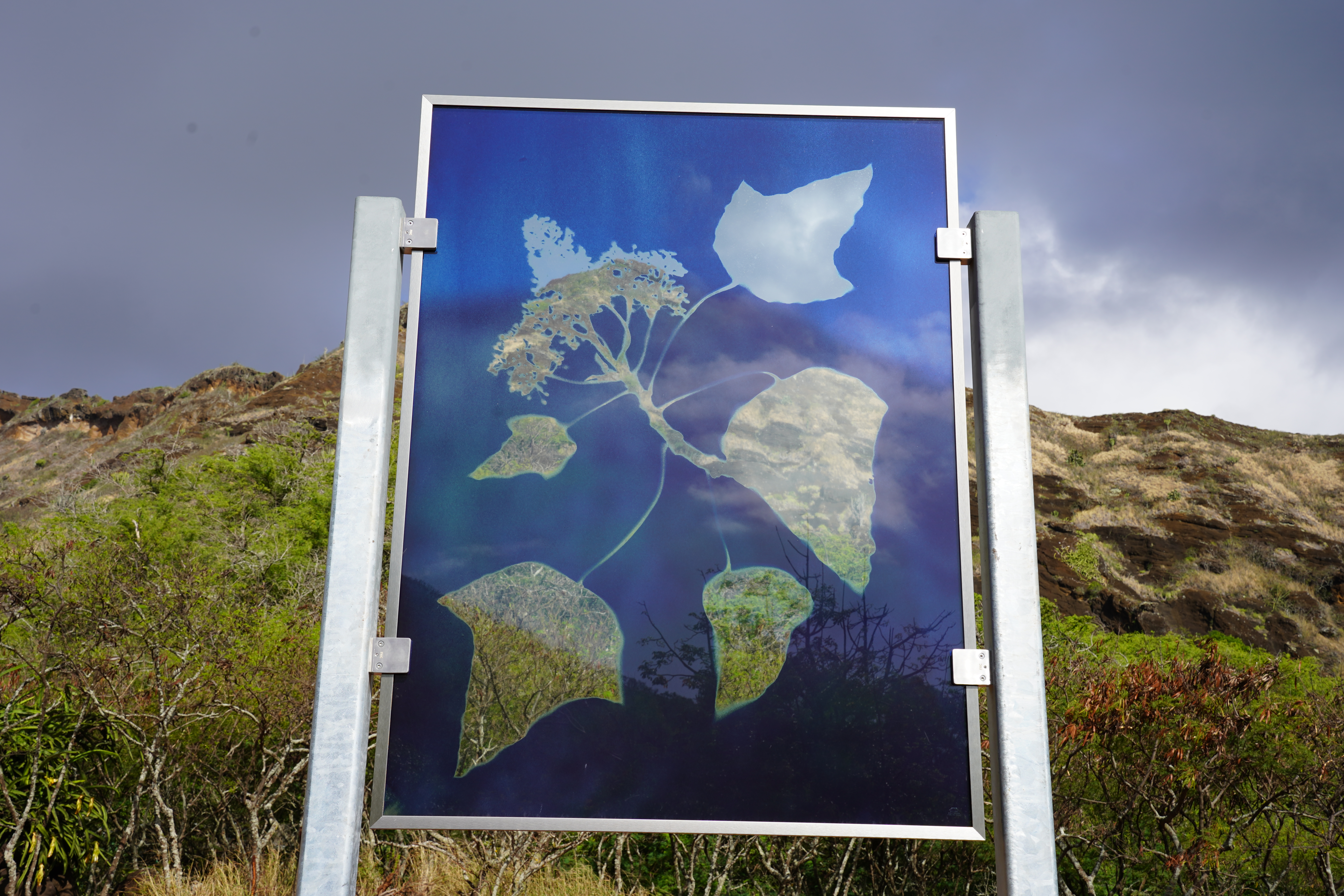
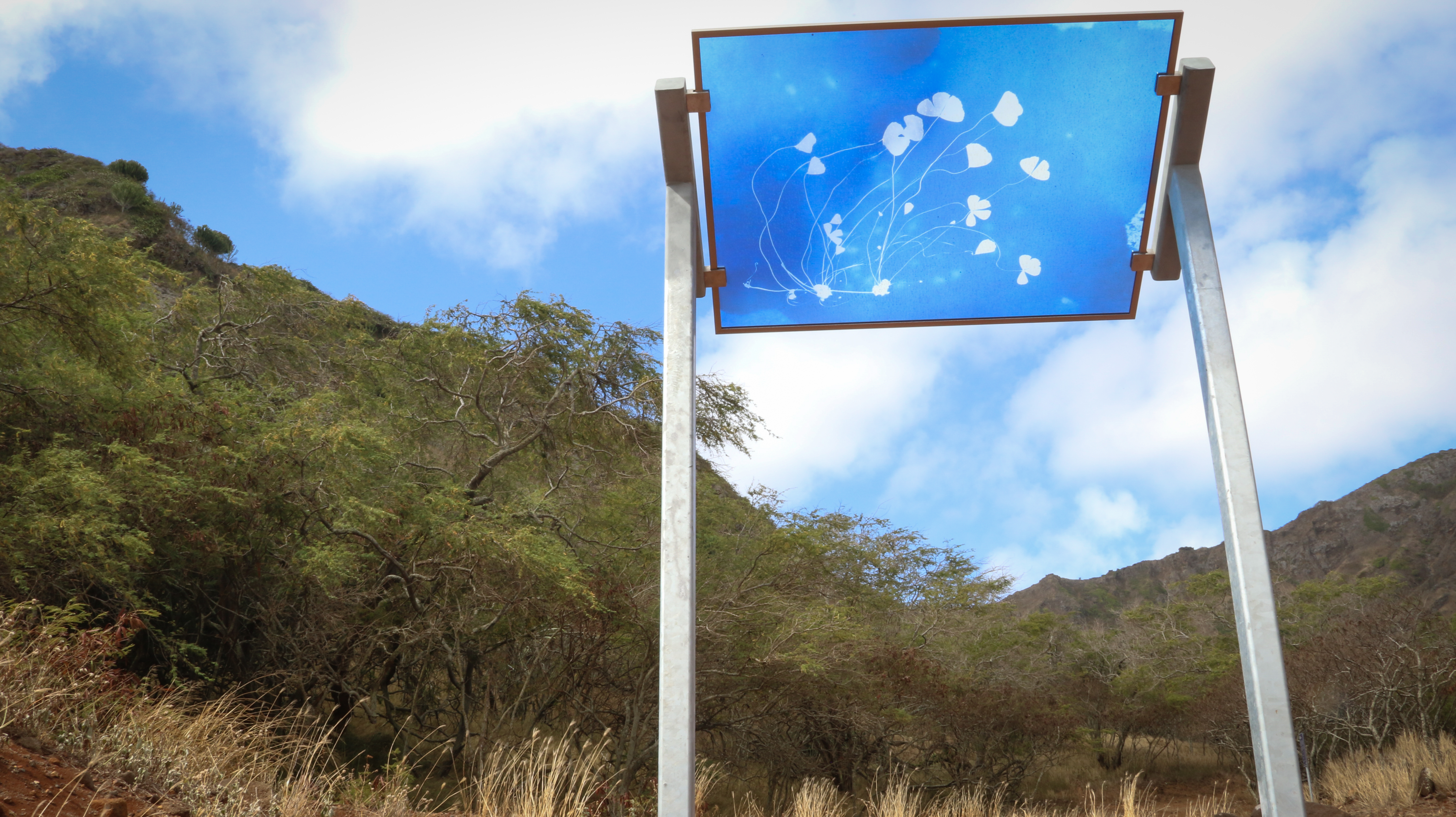
“Kuʻu Pua i Kohelepelepe” takes the form of 3 sculptures featuring cyanotype images of plants. Cyanotype is a photographic process resulting in blue images, and for the photography nerds out there, it was used to make the first photographically-illustrated book, featuring prints of British algae made by one of he first female photographers and botanists, Anna Atkins.
2 of the images feature plants that would be found in kuʻokoʻa gardens: koa and kukui, which often reference strength and enlightenment. Then thereʻs the ʻihiʻihilauakea, an endemic and endangered semi-aquatic fern that grows in small areas of Maunalua. The name ʻIhiʻihilauakea resonates further once you know that it was also the name of a well-loved female aliʻi of old who lived in Maunalua, itʻs the wind-name of Hanauma Bay, and itʻs also a place name of a crater along the rim of Hanauma Bay, further grounding this plant to where the artwork resides.
Yet some people may wonder why Pua is in the title if thereʻs not many pua, or flowers, in the artwork. So itʻs important to remember that there is always kaona (hidden or layered meaning) in ʻŌlelo Hawaiʻi, and “flower” is only one of the translations of the word. Pua also translates to child or descendant, someone who is an extension of your lineage. So yes, when Queen Liliʻuokalani sang about a never fading flower, it couldʻve been the flower of the ʻūlei, hibiscus, crown flower, or kukui of her gardens. But, it also could’ve been us, her people, who keep the pana of this land alive.
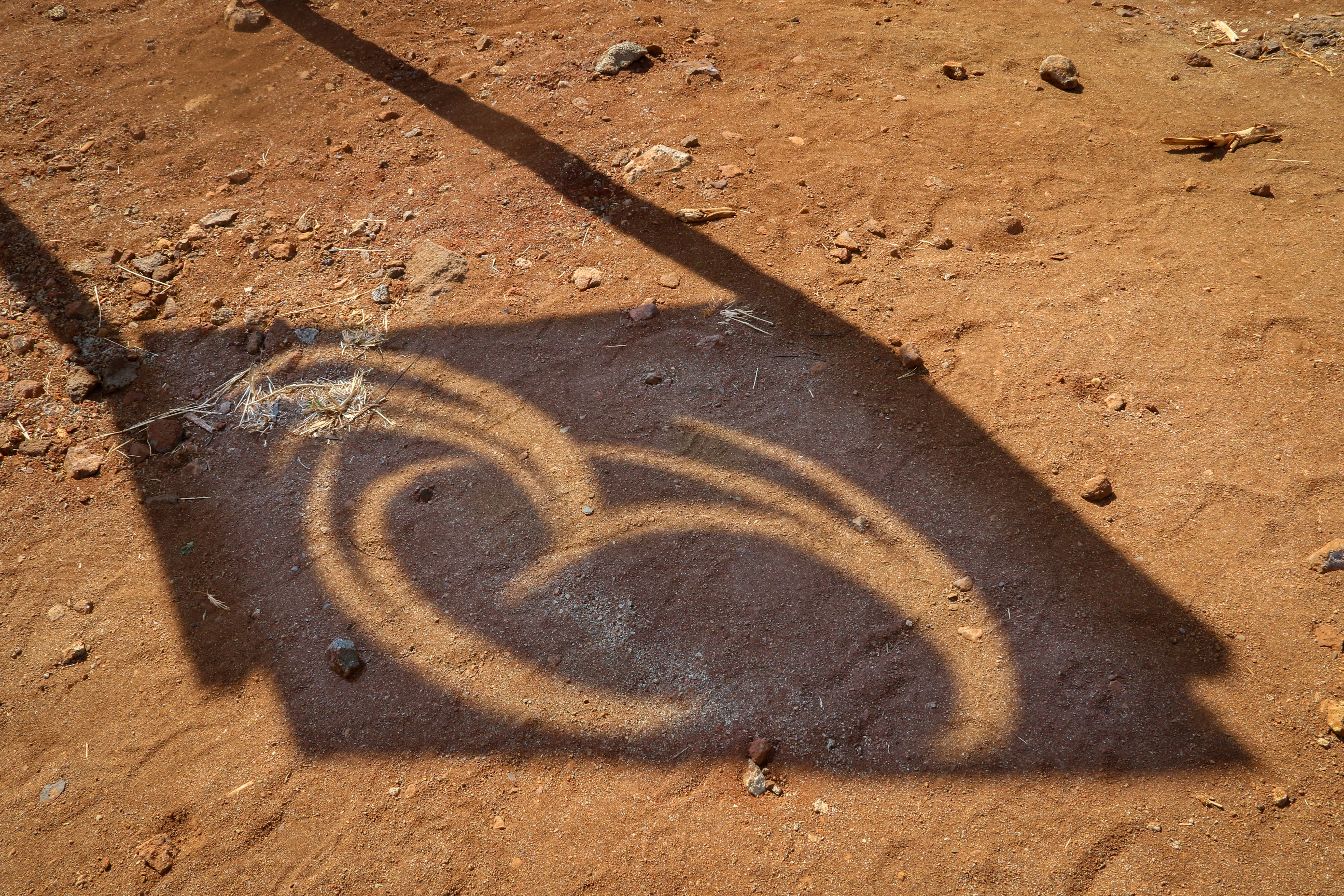
Each of these images are printed on glass, which cast a blue shadow, changing with the time of day and aligned to mark 3 significant days in Hawaiian history: January 17, marking the overthrow and more importantly the Onipaʻa March; July 31 for La Hoʻihoʻi Ea or Hawaiʻiʻs Restoration Day; and November 28, La Kuʻokoʻa or Hawaiʻiʻs Independence Day.
As visitors step up to or under each piece on a sunny day, they become engulfed by blue light, so that they too become a part of the piece, they become a living pua of this garden that we planted, a part of this wahi pana.
Koko, pana, kohe, pua. Blood, pulse, power, people.
Mahalo.
 Ualani Davis